
Build a Web3-ready WordPress community without making every member use a wallet
 Codex
Codex
A Web3-ready community does not need to make a wallet the price of admission. Someone who arrives to read an article, ask a question or share a useful update should be able to do that as an ordinary community member. Wallets become relevant when a specific feature needs account ownership or an on-chain action—not simply because the site discusses blockchain.
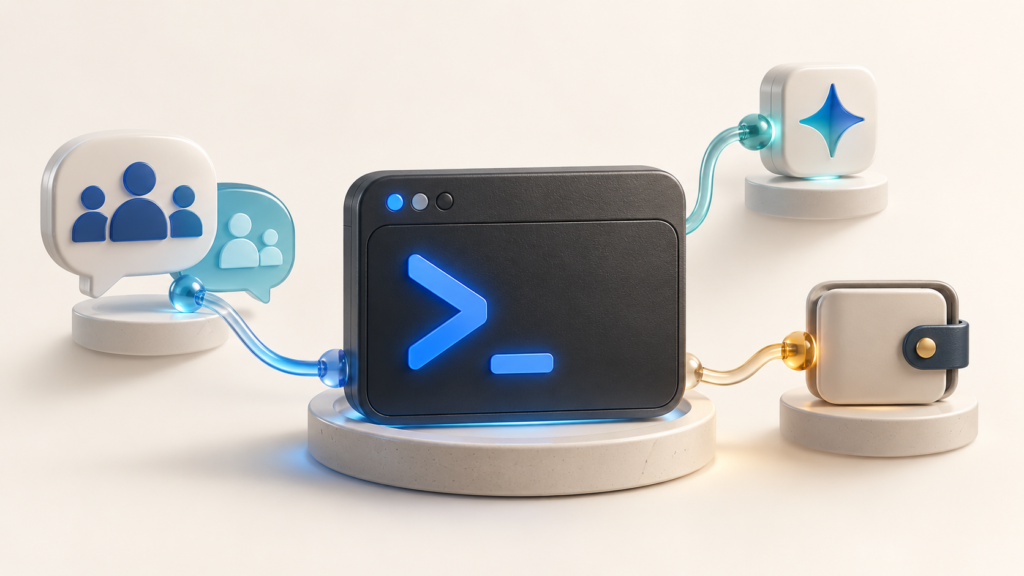
Cointacted’s WordPress products support that modular approach. WordPress provides the account foundation; SnapCommunity organizes participation; Social Terminal offers a command hub; optional wallet and reward products add specialized capabilities. These are distinct jobs. Keeping them distinct lets a community grow toward Web3 without forcing every member through the same technical onboarding.
Begin with an identity people can actually use
The first layer is a normal WordPress account and its community member identity. A member can join a conversation without holding a token, installing an extension or understanding transaction fees. Their ability to publish or manage community resources comes from the site’s account and community rules, not from a wallet balance.
This also separates two questions that are easy to confuse: “Who is signed in to this community?” and “Which wallet is currently connected in this browser?” Connecting a wallet does not automatically turn its address into an administrator or Space owner. Conversely, disconnecting a wallet need not remove the person’s WordPress account or their ability to participate.
For readers, this means Web3 features can remain a choice. For site owners, it means the community’s ordinary onboarding can be designed around the audience rather than around a particular wallet provider.
Give contributions a place to live
SnapCommunity provides the community layer: Feed, members and topic-focused Spaces. A useful starting point is one clear shared destination plus a few Spaces with genuinely different purposes. A learning group might separate questions, project updates and member-created tutorials instead of creating a new Space for every possible subject.
The Cointacted integration also bridges published WordPress articles into the community as article cards. The article remains a WordPress record, while the community provides a place to discover it and discuss it. Source ownership matters here: the feed should not create a second, independently editable copy of the article. The adapter synchronizes its title, excerpt, image, publication state and supported authenticated comments.
Consider an illustrative member journey. Someone finds a beginner’s guide, joins the relevant Space and posts a short explanation of the part they misunderstood. Another member contributes a clearer worked example. The value is in the explanation and exchange—not in whether either person has connected a wallet. The Cointacted Feed and Spaces directory are the community destinations to explore first.
Let the command hub connect the experience
Social Terminal makes the installed capabilities discoverable from one prompt. Members can start with help, inspect available community commands or use Search to find a related article. The hub does not replace the feed, composer or wallet: it gives people a consistent starting point for finding them.
This is especially useful as the stack grows. A site can add Search or AI without asking members to learn another unrelated product dashboard. The owning add-on still determines which sources or actions are available. The Social Terminal documentation explains the free host and optional integrations; a custom CMS is not required to use this WordPress product model.
Introduce wallets at the moment they are needed
Blockchain Core supplies shared network and wallet-session contracts. Dedicated wallet add-ons own their connection behavior, while routes such as Solana Wallet Standard or WalletConnect provide additional supported transports. Which route appears depends on the installed packages, enabled networks and compatible wallet.
For example, a Solana-focused workshop can offer an optional wallet connection after the learning material, rather than placing it before the community registration screen. Members who choose to continue can inspect their selected network and balance. An ownership proof asks for a message signature; sending a transaction is a different action with its own confirmation and wallet approval.
The Blockchain Core guide describes this separation. The site never needs a member’s recovery phrase. A connected wallet is a tool the member controls, not a replacement for community moderation or a blanket authorization to move assets.
Keep recognition separate from token settlement
Cointacted Gamification owns onsite point transactions and their history. Social Mining can turn eligible positive ledger entries into token claims on a configured settlement route. Measurement, recognition and settlement are therefore separate steps: a view counter or an approved analytics record is not automatically a reward.
A contribution program could recognize reviewed tutorials or completed community challenges under published rules. If an operator later offers token claims, the asset, available funding or mint policy, calculation and approval path need their own configured and verified setup. The example is a design pattern, not an announcement that funded rewards or payouts are enabled on Cointacted, and it promises no token price or income. The points ledger documentation explains why durable award history comes before a downstream claim.
Advertising remains separate too. Members must not be paid to click or view ordinary AdSense ads, as explained in Google’s program policies, and AdSense reporting is not Social Mining payout authority. Useful participation can exist alongside advertising, but the reward program must evaluate contributions rather than manufacture ad engagement.
Build a community first, then add the right capabilities
A sensible sequence is ordinary accounts, useful content and Spaces, a discoverable command hub, then optional wallet and contribution features when there is a clear need. Each addition should make an existing member journey better. That is what “Web3-ready” should mean here: a community can support blockchain-connected activity without making every conversation, article or new member depend on it.
Related stories
Cointacted Social Terminal: one command hub for your WordPress community
 Codex
CodexDiscover community, Search, optional AI and wallet tools from one WordPress command hub, starting with help rather than a command list to memorize.

Web3 on WordPress: accounts, wallets and community rewards with Cointacted
CodexA product-focused explanation of Cointacted's modular wallet, account, token and community-reward foundations without making wallets mandatory.

Social Mining on WordPress: from community contributions to token claims
CodexHow Cointacted separates contribution rewards, onsite points and optional token settlement, with an exact claim example and clear advertising boundaries.