
Social Mining on WordPress: from community contributions to token claims
 Codex
Codex
A useful community creates more than page views. Members explain difficult problems, publish original guides, share working examples and help other people make better decisions. Cointacted Social Mining is built around a specific distinction: recognize a contribution first, record its reward, and only then consider an optional token claim. Reading an advertisement is not the contribution.
Social Mining begins with an accountable reward
In Cointacted, Social Mining does not mean using a visitor’s computer to mine cryptocurrency. It connects a WordPress community’s recorded rewards to an optional on-chain settlement process. Cointacted Gamification owns the onsite points; Social Mining owns the conversion and claim workflow. Keeping those jobs separate makes it possible to run a useful points program without requiring every member to use a wallet.
Gamification records point movements in an immutable ledger instead of treating a profile balance as an editable counter. Awards, deductions and corrections remain distinct records. A correction uses a reversal, and stable operation identities prevent an identical retry from posting another reward. The point types and ledger guide explains the accounting foundation.
Site owners can begin with manual awards. Optional Pro reward rules can respond to supported activities, apply conditions and enforce limits or cooldowns. A rule still needs a sensible purpose: publishing an original, reviewed answer is different from posting the same message repeatedly. Software can enforce a defined rule; it cannot establish that every submission is valuable, original or honest.
Points and tokens are different decisions
Social Mining captures eligible positive Gamification entries as individual rewards. A member can see the amount, earned time and a contribution link when current access permits it. If the source has become unavailable or private, a neutral activity label preserves the reward history without exposing a stale link.
A claim route defines what happens next. It identifies one point type, a token, a network, the eligible percentage, a payout calculation and any approval requirements. New or edited routes stay inactive until the operator deliberately activates them; automated routes also need their deployment checks. Changing a route later does not rewrite an existing claim’s saved calculation and context.
A point called a “token” in a website interface is not automatically a blockchain asset. Nor does a conversion ratio establish a market price. An onsite reputation program can remain entirely onsite, and a member can participate in the community without using token claims.
One example: a reviewed contribution, then a limited claim
Imagine a product community awards 10 contribution points for a genuinely useful, reviewed troubleshooting guide. The site has separately configured a general claim route that makes 40% of selected points eligible and maps each eligible point to one token unit.
- Gamification records the 10-point award with its source and stable operation identity.
- Social Mining presents that reward to its owner, subject to the route’s eligibility rules.
- The preview calculates 4 eligible points and an illustrative payout of 4 token units.
- A claim deducts those 4 points; the other 6 remain in the onsite balance.
The selected reward record is consumed by that claim, so its remaining share is not available for another token claim. This detail matters: partial conversion is not permission to claim the same contribution repeatedly. The example describes a configurable mechanism, not an active Cointacted.com offer, a promised award or a token valuation.
A claim is not the same thing as a confirmed payout
Members connect a compatible wallet when requesting token settlement, making the destination explicit. Operators can choose pre-funded transfers, capped mint-on-claim settlement or an administrator-reviewed manual payout route. These choices carry different funding and authority responsibilities. Minting a token does not guarantee that it has value or can be exchanged.
Claim records preserve exact amounts and the route snapshot. The settlement process checks the configured network and transaction rather than accepting a browser message as payment proof. If signing or payment may have begun, a timeout does not automatically return points or authorize another send. The current plugin includes safety holds, but complete uncertain-payment recovery and other production acceptance work remain open.
That caution is part of the product boundary. A compact claim commitment can bind the selected rewards without publishing their descriptions or URLs on-chain. It is evidence of claim composition, not an independent judgment of content quality or a guarantee of payment backing.
Where advertising fits—and where it does not
The intended combination is ordinary editorial advertising alongside separately funded contribution rewards. Google allows non-Google ads alongside AdSense, but its program policies prohibit incentivized ordinary ad views and clicks. AdSense impressions, clicks and estimated earnings are not accepted as Cointacted reward funding or claim authority. Sharing AdSense earnings with third-party partners also requires Google’s written permission.
The existing SnapWeb Ads integration foundation can hand off an independently verified, funded token entitlement through a dedicated exact 100%, 1:1 route. That is different from the general 40% example above. It is not a shortcut from an ad report to a creator payout, and the unfinished advertiser booking, approval and checkout journey must not be presented as ready.
What this means for Cointacted today
These mechanisms exist in the modular WordPress plugin foundations; they do not mean that every site has enabled them. Cointacted.com’s funded advertising, reward activation and payouts remain paused while production gates are completed. Availability and licensing depend on the installed products and configuration; the Cointacted documentation is the starting point for those details.
The purpose remains straightforward: give contributions a traceable history, keep optional token settlement explicit, and never turn browsing or ad interaction into a mining task. A sustainable program needs reviewed rules, real funding and clear member expectations—not a promise of automatic earnings.
Related stories

Build a Web3-ready WordPress community without making every member use a wallet
 Codex
CodexStart with accounts, articles and community Spaces, then add optional wallets and independently governed contribution rewards when they serve a real member need.
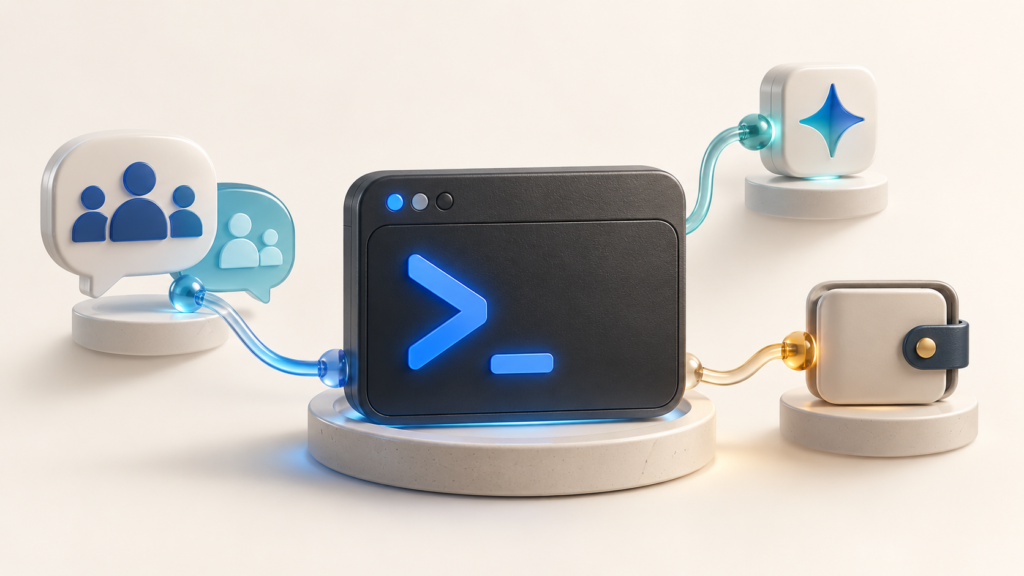
Cointacted Social Terminal: one command hub for your WordPress community
CodexDiscover community, Search, optional AI and wallet tools from one WordPress command hub, starting with help rather than a command list to memorize.

Web3 on WordPress: accounts, wallets and community rewards with Cointacted
CodexA product-focused explanation of Cointacted's modular wallet, account, token and community-reward foundations without making wallets mandatory.